Showing posts with label race board. Show all posts

Sunday, February 1, 2015

Stand Up Paddle board volume explained- ways to determine the proper board volume


We are often asked: "What SUP board volume is best for me?"
The short answer is: "It depends.  For beginners we recommend a volume of about twice your body weight."
Here is a longer explanation of our board volume recommendations:
First of all, you need to know your body weight into kg.
To convert from pounds to kg divide your weight by 2.2 (1 kg = 2.2 lbs)
Using myself as an example:  my weight is 195 lb. divided by 2.2= approx. 88 kg.
The metric system makes it easy to calculate lift created by volume as one kg is equals to the weight of one liter of water by definition (note that salt water is slightly denser so the same board will float slightly better in the ocean than in freshwater).   Interestingly most board dimensions are quoted in feet and inches but volume is always quoted in metric liters for this reason.
Basically: one liter of volume displaces one liter of water and therefore creates one kg of lift, so one liter of board volume will float one kg of weight.
For beginners, we recommend body weight in kg= liters x 2 (approximately) or about 176 liters volume for my weight of 88 kg.  This means that when I stand on the board, it will be pushed about half way under water to displace enough water to float my body weight plus equipment weight.   Please note that more volume will not necessarily make the board more stable.  Side to side stability is a result of the width of the board and the thickness of the rails and to a lesser degree the length of the board.  A thicker board can actually be less stable as the feet are higher off the water, raising the center of gravity.
For racing and touring you can go with a higher volume as thicker, high volume rails can add secondary stability to a narrower hull that has less resistance than a wider board.  In downwinders especially, high volume in the front of the board works well to keep the nose from plowing deep into the trough.
If high performance SUP surfing is your goal, as you improve you can gradually lower the volume of the boards you use since a lower volume board will generally surf better but will also be much harder to balance on and control, making low volume,high performance boards very difficult to learn on.  
Expert SUP surfers can use a board volume as low as their body weight plus board, paddle, clothing and gear weight plus a few liters extra, or about 100 Liters volume for my body weight.  At this volume the board will barely float when not moving.  Some pros even use boards that don't float them when standing still, they need the dynamic lift created from moving through the water to keep them afloat, the board will sink if they stop paddling, with the board volume in liters slightly less than their body weight plus board and equipment weight in kg.  
Once again:  The body weight times two is only a rough guide to recommended volume as the width and volume distribution of the board has a bigger impact on how stable the board will be.  Although we recommend buying a board that is challenging to balance on at first since your balance will quickly improve with practice, don't make the mistake of buying  a board that is too small for your skill level as that can be very frustrating.  The point is to have FUN!
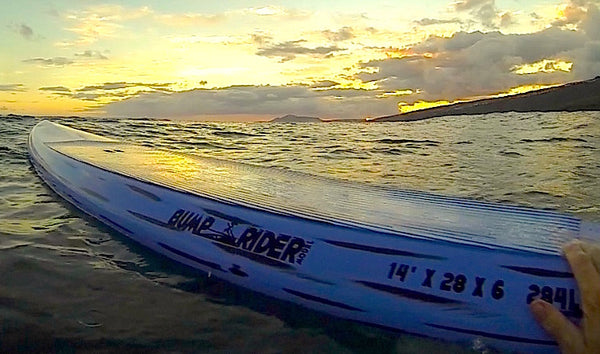
SUP board volume
The 14' x 28" x 6" Bump Rider is a downwind board with 284 Liters of volume

Aloha, Robert Stehlik
www.blueplanetsurf.com

Sunday, November 6, 2011

12'6" SUP race board speed test by Robert Stehlik

12'6 Stand Up Paddle Race board testing day

It's been a while since our unlimited board test, where I said we would soon organize a test of 12'6" and 14' boards.
My friend Scotty had two 12'6 Hobie race boards and a Bark that he wanted to comparison test.  I brought four more 12'6's for a total of 7 boards to test, which worked out perfectly as seven testers showed up bright and early on a Saturday morning (Nov. 6th, 2011) to go through the rigorous 14 laps needed to test all the boards.  Photos and specs of the individual boards are shown below.   Unfortunately there were some wind gusts that affected times of the individual runs but because each board was tested in each run, these variations in conditions should average out over the results.  Also, some of us had to run 8 rounds as someone tested the same board twice somewhere along the way, which threw everything off a little but in the end everyone toughed it out and tested all seven boards.

After posting the unlimited test results on the Standup Zone forum, I got lots of good feedback that we tried to incorporate into this test, including recording the dimensions and weights of each board tested as well as taking pictures of each board outline and profile.  The test lap is a .21 course that runs downwind one way and upwind the other way.  Each tester used each board on one downwind and one upwind run with a 1-2 minute break in between.  As we were running many laps, the instructions were to make sure to keep their energy output consistent and not use all their strength in the first few laps to avoid slowing down towards the end of the test.  We also staggered the start with 10 seconds or so between each tester to avoid the "group effect" and switched boards randomly.

If you look at the test results spreadsheet, you will see that the times for Anders, the fastest tester, were quite consistent with a relatively small spread between fastest and slowest times, compared to some of the other testers that had a bigger spread between the slowest and fastest times. Everyone in the test was a capable paddler and I wanted to have testers of different abilities to make the results more relevant for the average users.  To give equal weight to each paddlers results, I ranked each individuals results and added them up for an average ranking, resulting in a somewhat different ranking than using the total times.

I brought a 12'6" x 29" touring board that we received as a sample from a manufacturer, so I thought this would be a good occasion to test it.  We were all disappointed by it's performance in comparison to the other boards in the test and it needs some improvement.  To be fair, it was designed to be a more stable and durable touring board, vs. the lightweight (and more expensive) pure raceboards it was tested against.  It was the widest, heaviest, and slowest board in the test.

I was somewhat surprised by the good results of the 12'6" Dennis Pang board.  It was the fastest board in the flatwater test in both overall time and individual rank results. Dennis custom made this board and we designed it mainly for downwinders and surf races, with quite a bit of rocker and a relatively wide tail for stability.  The entry is not very piercing and a little splashy, so the fast times were somewhat of a surprise.  It shows that rocker does not necessarily make a board slow in flatwater and that a clean entry is not all that matters.  The wide tail and generous volume also makes this board fairly stable and user friendly, so even the less experienced paddlers got good results.

The unconventional Starboard ACE also has a somewhat splashy entry but generally works well in these kind of conditions. It takes some getting used to, which may have worked against it a little in the results.  The Everpaddle 12'6" also has a narrow tail which gives it a clean exit but also makes it less stable.  The results show that this board worked better for the experienced racers than for the less experienced ones.  Scotty's Hobie boards had a good feel and work great in downwinders according to him.  It was no surprise that they, as well as the Bark and Everpaddle boards all had good results in the test.  So, what did we learn from this test?  I'm still figuring that out but my hope is that these tests will make the next generation of boards even faster, well balanced, and user friendly.

Each tester made some notes on the boards tested after each run and I included the comments with each board.  They are from seven individuals, so some may seem contradictory at times.  I hope some of you can add your thoughts by making comments below, feedback is always welcome and encouraged.

Link to results spreadsheet


The test team: Denis, Rob, Alex, Scotty, Anders, Dr. Dan, Lokelani


The seven boards we tested (subjective rider comments as recorded after each run)

12'6" x 27" x 6" Everpaddle custom
weight: 25.75 lbs
rider comments:
smooth, tippy, low rocker
stable but not heavy, glides well, quick on start
comfortable
great upwind, stable and fast
tippy, paddles straight
rolly, a bit heavy


12'6" x 27" x 9" Starboard Ace 2011
weight: 30.5 lbs
rider comments:
Bouncy
tippy, smooth, glide
sluggish feel, noisy, stable
good all around but harder to steer upwind
feels like it pushes a lot of water
buoyant and bouncy
clean water exit off tail


12'6" x 28.75" x 6.6" Hobie Bamboo Elite 2012
28 lbs.
rider comments:
good feel, narrow stance
thick from middle to tail, slower than expected
feels like it drags more than other Hobie
downwind good, upwind more drift
stable, good upwind
like the feel


12'6" x 27.75" x 6.6" Hobie Elite Race 2011
weight: 27 lbs
rider comments:
Like the feel
little tippy, good glide
glides well, stable
downwind good, upwind harder to steer
fast off the line
entry feels good, narrow stance


12'6" x 29" x 6" Blue Planet touring
weight: 33.25 lbs
rider comments:
needs work
heavy, stable, slow start, glides well, tracks well upwind
hard to being up to speed, maintain speed
Heavy, no play in board
heavy, stable


12'6" x 27.75" x 6.25" Dennis Pang custom
weight: 24.5 lbs
rider comments:
fast, good rocker
light, tippy, very fast on start, felt like it pushed water instead of cut & glide
light, easy to bring up to speed
Like it! very stable, tracks & glides well
less tracking, light, fast
tippy, glides well, good upwind
light, splashes a lot


12'6" x 27.75" x 6.25" Bark custom
weight: 25.5 lbs
rider comments:
good glide
light, fast, tippy
upwind hard to control
pretty stable, cut through wind well
faster than I expected
tracks well


Link to results spreadsheet


Many thanks to our volunteer test team:
Anders

Lokelani

Alex

Scotty

Denis

Dr. Dan

The photos below were taken by Alex Nix, who also made my cool new custom made double bend paddle in the pictures.


Here is a short video with headcam footage taken at the test:


Aloha, Robert Stehlik

www.blueplanetsurf.com