Connor Baxter has been dominating the SUP race scene this year, winning races almost every weekend on Maui, Oahu and internationally. He finished the 32 mile Molokai to Oahu race in an incredible time of 4:26, which was 28 minutes faster than the previous record.
After the 2011 Duke's race, which was part of the annual Duke's Fest, I had a chance to sit down with him for a personal interview. Evan Leong of standuppaddlesurf.net filmed and edited.
Aloha, Robert Stehlik
www.blueplanetsurf.com
Also below, find some of the videos edited and posted by Connor Baxter.
Double click to watch the videos full screen.
Africa SUPfari:
Connor Surfing:

Surfing and Stand Up Paddling as Zen arts. Written by Len Barrow and Robert Stehlik. Focus and paying attention to technique, equipment, mental aspects, the interplay with nature and others.
Wednesday, November 23, 2011


Sunday, November 6, 2011
12'6" SUP race board speed test by Robert Stehlik
12'6 Stand Up Paddle Race board testing day
It's been a while since our unlimited board test, where I said we would soon organize a test of 12'6" and 14' boards.
My friend Scotty had two 12'6 Hobie race boards and a Bark that he wanted to comparison test. I brought four more 12'6's for a total of 7 boards to test, which worked out perfectly as seven testers showed up bright and early on a Saturday morning (Nov. 6th, 2011) to go through the rigorous 14 laps needed to test all the boards. Photos and specs of the individual boards are shown below. Unfortunately there were some wind gusts that affected times of the individual runs but because each board was tested in each run, these variations in conditions should average out over the results. Also, some of us had to run 8 rounds as someone tested the same board twice somewhere along the way, which threw everything off a little but in the end everyone toughed it out and tested all seven boards.
After posting the unlimited test results on the Standup Zone forum, I got lots of good feedback that we tried to incorporate into this test, including recording the dimensions and weights of each board tested as well as taking pictures of each board outline and profile. The test lap is a .21 course that runs downwind one way and upwind the other way. Each tester used each board on one downwind and one upwind run with a 1-2 minute break in between. As we were running many laps, the instructions were to make sure to keep their energy output consistent and not use all their strength in the first few laps to avoid slowing down towards the end of the test. We also staggered the start with 10 seconds or so between each tester to avoid the "group effect" and switched boards randomly.
If you look at the test results spreadsheet, you will see that the times for Anders, the fastest tester, were quite consistent with a relatively small spread between fastest and slowest times, compared to some of the other testers that had a bigger spread between the slowest and fastest times. Everyone in the test was a capable paddler and I wanted to have testers of different abilities to make the results more relevant for the average users. To give equal weight to each paddlers results, I ranked each individuals results and added them up for an average ranking, resulting in a somewhat different ranking than using the total times.
I brought a 12'6" x 29" touring board that we received as a sample from a manufacturer, so I thought this would be a good occasion to test it. We were all disappointed by it's performance in comparison to the other boards in the test and it needs some improvement. To be fair, it was designed to be a more stable and durable touring board, vs. the lightweight (and more expensive) pure raceboards it was tested against. It was the widest, heaviest, and slowest board in the test.
I was somewhat surprised by the good results of the 12'6" Dennis Pang board. It was the fastest board in the flatwater test in both overall time and individual rank results. Dennis custom made this board and we designed it mainly for downwinders and surf races, with quite a bit of rocker and a relatively wide tail for stability. The entry is not very piercing and a little splashy, so the fast times were somewhat of a surprise. It shows that rocker does not necessarily make a board slow in flatwater and that a clean entry is not all that matters. The wide tail and generous volume also makes this board fairly stable and user friendly, so even the less experienced paddlers got good results.
The unconventional Starboard ACE also has a somewhat splashy entry but generally works well in these kind of conditions. It takes some getting used to, which may have worked against it a little in the results. The Everpaddle 12'6" also has a narrow tail which gives it a clean exit but also makes it less stable. The results show that this board worked better for the experienced racers than for the less experienced ones. Scotty's Hobie boards had a good feel and work great in downwinders according to him. It was no surprise that they, as well as the Bark and Everpaddle boards all had good results in the test. So, what did we learn from this test? I'm still figuring that out but my hope is that these tests will make the next generation of boards even faster, well balanced, and user friendly.
Each tester made some notes on the boards tested after each run and I included the comments with each board. They are from seven individuals, so some may seem contradictory at times. I hope some of you can add your thoughts by making comments below, feedback is always welcome and encouraged.
Link to results spreadsheet

The test team: Denis, Rob, Alex, Scotty, Anders, Dr. Dan, Lokelani
The seven boards we tested (subjective rider comments as recorded after each run)
12'6" x 27" x 6" Everpaddle custom
weight: 25.75 lbs
rider comments:
smooth, tippy, low rocker
stable but not heavy, glides well, quick on start
comfortable
great upwind, stable and fast
tippy, paddles straight
rolly, a bit heavy

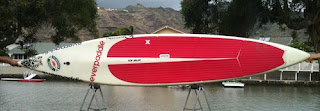
12'6" x 27" x 9" Starboard Ace 2011
weight: 30.5 lbs
rider comments:
Bouncy
tippy, smooth, glide
sluggish feel, noisy, stable
good all around but harder to steer upwind
feels like it pushes a lot of water
buoyant and bouncy
clean water exit off tail


12'6" x 28.75" x 6.6" Hobie Bamboo Elite 2012
28 lbs.
rider comments:
good feel, narrow stance
thick from middle to tail, slower than expected
feels like it drags more than other Hobie
downwind good, upwind more drift
stable, good upwind
like the feel


12'6" x 27.75" x 6.6" Hobie Elite Race 2011
weight: 27 lbs
rider comments:
Like the feel
little tippy, good glide
glides well, stable
downwind good, upwind harder to steer
fast off the line
entry feels good, narrow stance


12'6" x 29" x 6" Blue Planet touring
weight: 33.25 lbs
rider comments:
needs work
heavy, stable, slow start, glides well, tracks well upwind
hard to being up to speed, maintain speed
Heavy, no play in board
heavy, stable


12'6" x 27.75" x 6.25" Dennis Pang custom
weight: 24.5 lbs
rider comments:
fast, good rocker
light, tippy, very fast on start, felt like it pushed water instead of cut & glide
light, easy to bring up to speed
Like it! very stable, tracks & glides well
less tracking, light, fast
tippy, glides well, good upwind
light, splashes a lot


12'6" x 27.75" x 6.25" Bark custom
weight: 25.5 lbs
rider comments:
good glide
light, fast, tippy
upwind hard to control
pretty stable, cut through wind well
faster than I expected
tracks well


Link to results spreadsheet
Many thanks to our volunteer test team:


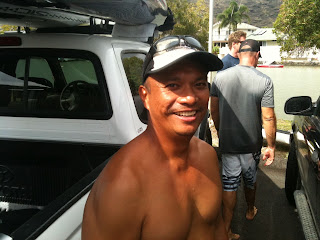


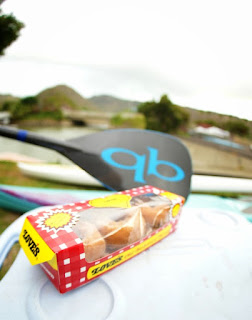
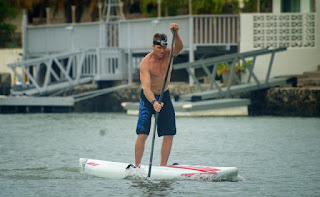
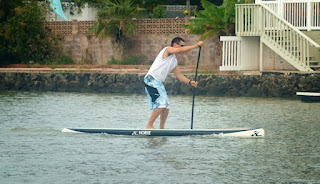
The photos below were taken by Alex Nix, who also made my cool new custom made double bend paddle in the pictures.






Aloha, Robert Stehlik
www.blueplanetsurf.com
It's been a while since our unlimited board test, where I said we would soon organize a test of 12'6" and 14' boards.
My friend Scotty had two 12'6 Hobie race boards and a Bark that he wanted to comparison test. I brought four more 12'6's for a total of 7 boards to test, which worked out perfectly as seven testers showed up bright and early on a Saturday morning (Nov. 6th, 2011) to go through the rigorous 14 laps needed to test all the boards. Photos and specs of the individual boards are shown below. Unfortunately there were some wind gusts that affected times of the individual runs but because each board was tested in each run, these variations in conditions should average out over the results. Also, some of us had to run 8 rounds as someone tested the same board twice somewhere along the way, which threw everything off a little but in the end everyone toughed it out and tested all seven boards.
After posting the unlimited test results on the Standup Zone forum, I got lots of good feedback that we tried to incorporate into this test, including recording the dimensions and weights of each board tested as well as taking pictures of each board outline and profile. The test lap is a .21 course that runs downwind one way and upwind the other way. Each tester used each board on one downwind and one upwind run with a 1-2 minute break in between. As we were running many laps, the instructions were to make sure to keep their energy output consistent and not use all their strength in the first few laps to avoid slowing down towards the end of the test. We also staggered the start with 10 seconds or so between each tester to avoid the "group effect" and switched boards randomly.
If you look at the test results spreadsheet, you will see that the times for Anders, the fastest tester, were quite consistent with a relatively small spread between fastest and slowest times, compared to some of the other testers that had a bigger spread between the slowest and fastest times. Everyone in the test was a capable paddler and I wanted to have testers of different abilities to make the results more relevant for the average users. To give equal weight to each paddlers results, I ranked each individuals results and added them up for an average ranking, resulting in a somewhat different ranking than using the total times.
I brought a 12'6" x 29" touring board that we received as a sample from a manufacturer, so I thought this would be a good occasion to test it. We were all disappointed by it's performance in comparison to the other boards in the test and it needs some improvement. To be fair, it was designed to be a more stable and durable touring board, vs. the lightweight (and more expensive) pure raceboards it was tested against. It was the widest, heaviest, and slowest board in the test.
I was somewhat surprised by the good results of the 12'6" Dennis Pang board. It was the fastest board in the flatwater test in both overall time and individual rank results. Dennis custom made this board and we designed it mainly for downwinders and surf races, with quite a bit of rocker and a relatively wide tail for stability. The entry is not very piercing and a little splashy, so the fast times were somewhat of a surprise. It shows that rocker does not necessarily make a board slow in flatwater and that a clean entry is not all that matters. The wide tail and generous volume also makes this board fairly stable and user friendly, so even the less experienced paddlers got good results.
The unconventional Starboard ACE also has a somewhat splashy entry but generally works well in these kind of conditions. It takes some getting used to, which may have worked against it a little in the results. The Everpaddle 12'6" also has a narrow tail which gives it a clean exit but also makes it less stable. The results show that this board worked better for the experienced racers than for the less experienced ones. Scotty's Hobie boards had a good feel and work great in downwinders according to him. It was no surprise that they, as well as the Bark and Everpaddle boards all had good results in the test. So, what did we learn from this test? I'm still figuring that out but my hope is that these tests will make the next generation of boards even faster, well balanced, and user friendly.
Each tester made some notes on the boards tested after each run and I included the comments with each board. They are from seven individuals, so some may seem contradictory at times. I hope some of you can add your thoughts by making comments below, feedback is always welcome and encouraged.
Link to results spreadsheet

The test team: Denis, Rob, Alex, Scotty, Anders, Dr. Dan, Lokelani
The seven boards we tested (subjective rider comments as recorded after each run)
12'6" x 27" x 6" Everpaddle custom
weight: 25.75 lbs
rider comments:
smooth, tippy, low rocker
stable but not heavy, glides well, quick on start
comfortable
great upwind, stable and fast
tippy, paddles straight
rolly, a bit heavy


12'6" x 27" x 9" Starboard Ace 2011
weight: 30.5 lbs
rider comments:
Bouncy
tippy, smooth, glide
sluggish feel, noisy, stable
good all around but harder to steer upwind
feels like it pushes a lot of water
buoyant and bouncy
clean water exit off tail


12'6" x 28.75" x 6.6" Hobie Bamboo Elite 2012
28 lbs.
rider comments:
good feel, narrow stance
thick from middle to tail, slower than expected
feels like it drags more than other Hobie
downwind good, upwind more drift
stable, good upwind
like the feel


12'6" x 27.75" x 6.6" Hobie Elite Race 2011
weight: 27 lbs
rider comments:
Like the feel
little tippy, good glide
glides well, stable
downwind good, upwind harder to steer
fast off the line
entry feels good, narrow stance


12'6" x 29" x 6" Blue Planet touring
weight: 33.25 lbs
rider comments:
needs work
heavy, stable, slow start, glides well, tracks well upwind
hard to being up to speed, maintain speed
Heavy, no play in board
heavy, stable


weight: 24.5 lbs
rider comments:
fast, good rocker
light, tippy, very fast on start, felt like it pushed water instead of cut & glide
light, easy to bring up to speed
Like it! very stable, tracks & glides well
less tracking, light, fast
tippy, glides well, good upwind
light, splashes a lot
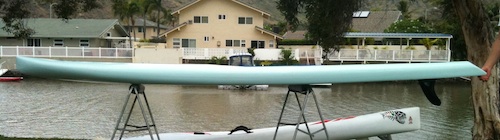

12'6" x 27.75" x 6.25" Bark custom
weight: 25.5 lbs
rider comments:
good glide
light, fast, tippy
upwind hard to control
pretty stable, cut through wind well
faster than I expected
tracks well


Many thanks to our volunteer test team:

Anders

Lokelani

Alex

Scotty

Denis

Dr. Dan
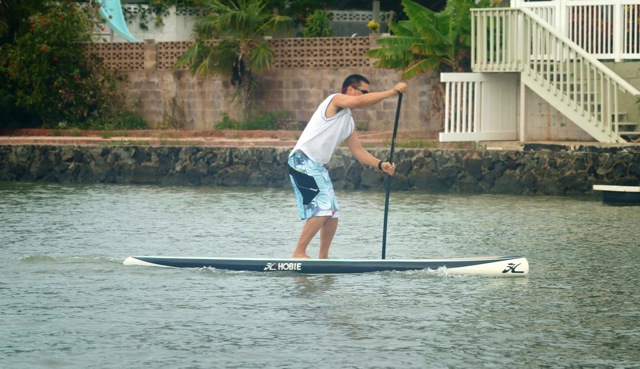
The photos below were taken by Alex Nix, who also made my cool new custom made double bend paddle in the pictures.




Here is a short video with headcam footage taken at the test:
Aloha, Robert Stehlik
www.blueplanetsurf.com
Thursday, November 3, 2011
Zen Chopsticks By Len Barrow
We here at Zen waterman have not done a Zen philosophy oriented article for a while so I thought I would have a go at it. This article has to do with a land-based program yet we will see how the Buddhist ideas inherent in the activity could be applied to our ocean activities
Every year I run a program with a few other teachers at Roosevelt High School (RHS) on Oahu. It’s a really beautiful project. The students learn about compassion and kindness by proactively helping the homeless through the Honolulu Institute for Human Services (IHS). The program is called RHS for IHS. The IHS is the key institution for helping the homeless on Oahu in Hawaii.
My motivation for engaging in this program is not religious. Despite this they come primarily from Zen Buddhist philosophy. As we shall see in the forthcoming story, the core of Mahayana Buddhism (which includes Zen in its scope) is compassion and kindness for others. The motivation to help others is the natural outcome of meditation and paying attention. This sounds weird but we shall explore this phenomena later in this article.
Here is another unusual fact about the Zen practice. According to the great Masters of old; without the motivation of compassion for others (Bodhichitta) focused in your practice, Zen is worse than poisonous garbage. In fact Zen done in self-interest is called “Zen sickness” in which one turns into a “hungry ghost clinging desperately to grasses and reeds” by the old masters. Trust me, you don’t want to be a hungry ghost!
I therefore try my best to steer away from my ego in the water and on land. It is the most difficult thing that I have ever tried to do. Despite this, social projects based on others well-being help me along the rugged Zen road.
As we were developing the program with my fellow teachers a question arose: “ How the hell do we get self-centered, arrogant modern teenagers to engage in compassionate social action?”. It was almost impossible to do it with adults and must surely be harder with teenagers given their egoism and our culture of selfishness.
We came up with a solution. I would give them a little Zen parable (among other things). This story worked extremely well in getting the students to have compassion for others. If a fourteen-year-old high school student can understand this to the point that they take social action, we as adults should be able to comprehend this mythology and take social action also. The “myth” goes something like this:
One day long ago a man was practicing Zen and managed to attain enlightenment. His insight was so great that it allowed him to visit heaven and hell. The man decided that he would visit hell first. As he entered the hell realm he was surprised at what he saw. There was a great rectangular table that was twenty feet long and a number of feet wide. There were ten people seated on one side of the table and ten people seated on the other side of the table. On the table were luxurious foods and the finest beverages that the lands could offer. Saphron and ambrosia scents wafted through the air. Well the monk was quite impressed. He stated “jee wiz, well hell is not that bad after all”. His thoughts were suddenly interrupted when he saw intense anger and frustration on everyone’s contorted faces. He quickly realized that the people were frustrated as they could not eat their food as their chopstiks were over three feet long! They could only look at it and they were extremely hungry, angry and sad. Hence, the hell dwellers spent their days yelling at each other and blaming the person opposite them for their predicament.
The monk asked the folks in Hell “how long have you been here?”. One individual viciously spat back and said, we have been like this for ten Kalpas!……(In Sanskrit: literally 10,000,000,000,000 trillion years!). The monk was aghast! He thought that hell was a really messed up place. The monk wondered what force could curse people to such a grim place? He hastened to get out of hell and go to heaven.
The monk then visited heaven. To his surprise he saw the same exact things that he saw in hell! There was a great rectangular table that was twenty feet long and a number of feet wide. There were also ten people seated on one side of the table and ten people on the other side of the table. To his amazement the people had great expressions of happiness and joy. In fact in their demeanor, the monk noticed a great serenity and calmness. The monk was perplexed as he saw that the occupants of heaven had the same three foot chopsticks!
The monk sat and watched the occupants of Heaven do something miraculous yet so simple. The heaven dwellers would use their huge chopsticks to pick up food from the other side of the table and HELP feed the other out of compassion and kindness. This act was kindly reciprocated by the person on the other side of the table and all were well fed, utterly content and wonderfully happy. The monk attained a deeper enlightenment when he saw this. He thought “To help another through compassion are the keys of enlightenment”. The monk also thought to himself that those in hell are in hell for the sole fact that they don’t help each other.
The monk reflected “how amazing it is that Heaven and Hell are exactly the same place”. He went back to his life with the conviction to be kind and compassionate to all beings with a will to help all. The monk lived happily ever after.
Well what does this have to do with the surf? I have another quick little story showing how you can apply the “Zen Chopsticks” spirit to the surf. I saw two beginners a few months ago floating around at Ala-Moana. Everyone in the surf was talking like “oh great, these people are just going to get in the way”. The locals were getting very frustrated and flustered at the novices. In a way they were creating their own hell by not helping them.
I am lucky because I am a teacher at heart and I asked the surfers if they wanted to catch waves. They heartily agreed and I positioned them to catch a swell. As each beginner caught waves they became very happy. Happiness is contagious. I was laughing my head off as they caught long rides while expressing gigantic smiles on their faces. It brought me back to a time when I was a beginner. This period was marked by pure stoke. I was so happy and conversely they were surf stoked. We have become wonderful friends since.
The point being, by helping others I was creating a heaven out of a hell! Mind you, in Zen, Heaven and Hell are the same place. In this philosophy, it is to the extent that you are compassionate and helpful that shape what world you are in. If you are a jerk to people, welcome to Hell. If you are GENUINELY compassionate and helpful, welcome to heaven. Can you now see that this is so? It is really that simple. If 120 fourteen-year-old students at Roosevelt High School can understand this and take social action with the homeless (they raised over 2,000 dollars and 2 TONS of canned goods), I hope we as mature adults can grasp this wonderful phenomena.
In this world of hyper-capitalism, ultra-violent video games, and pure narcissism, people wonder why they are so miserable despite having the luxuries of modern materialistic life. The answer is elementary. Quite simply they don’t choose to help others. Sometimes I am amazed at the behavior of some Americans (like myself). I am not a saint but it is my professional Anthropological opinion that it is almost ” hip” to not care for others in America. It is cool to flaunt your selfishness. If you don’t believe me “just turn on your t.v.” and flip through the channels. You may also choose to play your child’s video games, where you can literally shoot prostitutes after copulating with them (Grand Theft Auto) and bayonet enemy soldiers in the face (while getting points for it!?). Has not caring become part of our culture?
If it is we are in trouble. In a Zen view, not caring and being selfish will only lead a person to exist in a hell realm as a hungry ghost clings to brushes and weeds. When people don’t care about the environment and trash mother earth we get global warming and the like which is already affecting our happiness. In a way we have all collectively created a type of hell. When people don’t care about the social environment and others well-being you get social abuses like homelessness, war, violence in the ocean, spousal abuse, elderly abuse and child abuse. Again these are types of hells which we have collectively allowed to be created. If you want to understand the universe, just look in the mirror.
A question arises: where do you stand? Are you truly happy or frustrated? If you are not content , maybe moving outside of yourself to help strangers may be a solution to your sadness. It is not that hard to do once you get started.
In short, just spread da Aloha!!!!
Thanks to all the RHS teachers who developed this program. You are all bodhisattvas (Buddhist compassion super- saints) and you don’t even know it! That’s you Mr. Kim da surfa. Cheeeee haaaaa.
Aloha Len Barrow
Subscribe to:
Comments (Atom)