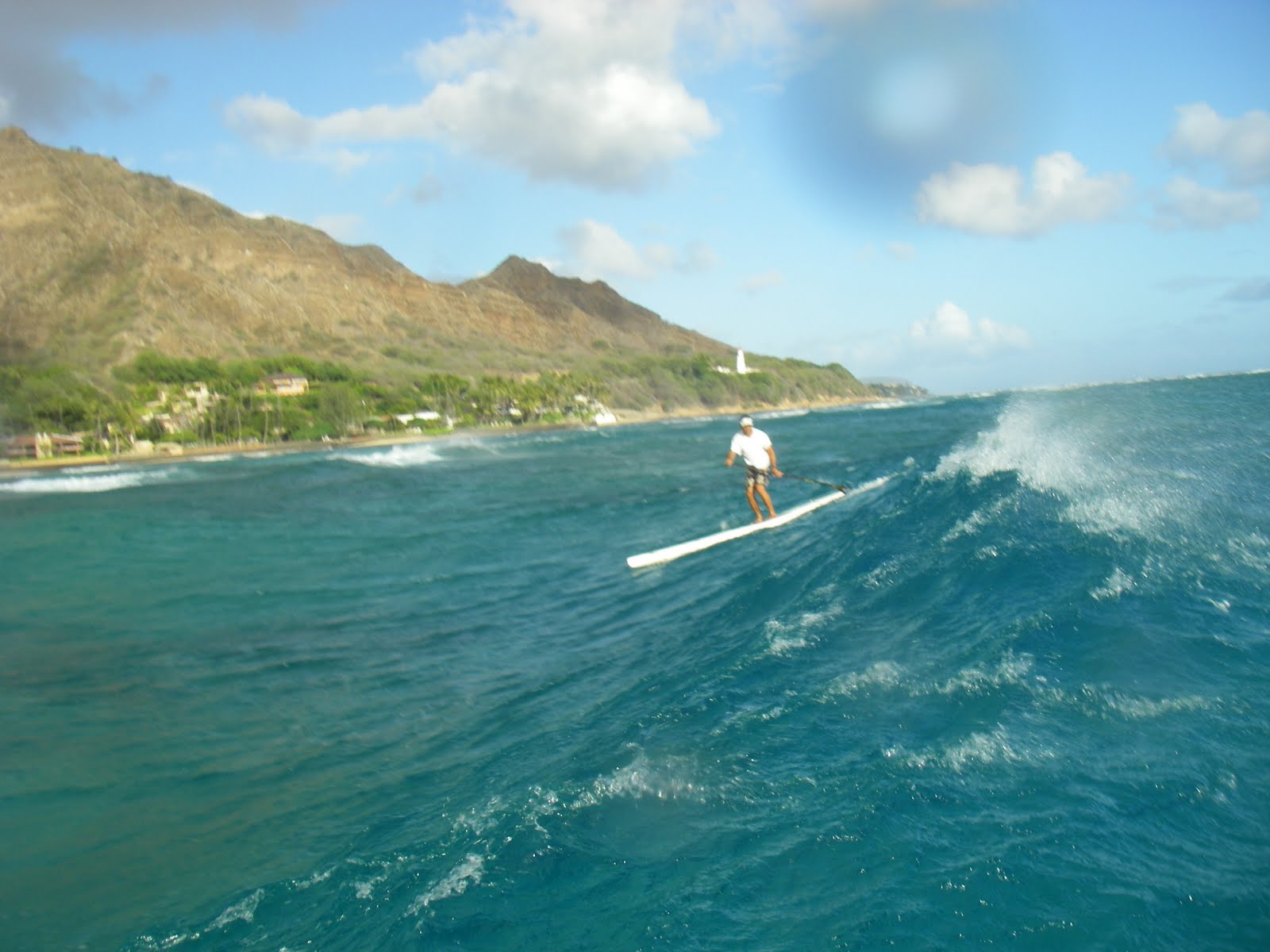
Surfing and Stand Up Paddling as Zen arts.
Written by Len Barrow and Robert Stehlik. Focus and paying attention to technique, equipment, mental aspects, the interplay with nature and others.
When you unpack a new SIC production board, you get the steering system in the form of a bunch of loose parts in a nice bag with no instructions. If you have never seen a rudder system installed it can be quite difficult to figure out how to do this correctly. You don't want to find out that you did not do it right in the middle of a race or when you are a few miles offshore. I have put quite a few of these together over the years and took some pictures to help others assemble it properly. Ask your dealer to do this for you if they know what to do, or you can do it yourself by following these steps. Since I wrote this post, SIC has come out with this video on how to install the rudder, so watch this (in addition to checking the photos in this post) and you will have no trouble installing the rudder system.
The SIC ASS- make sure you have all the parts
The SIC board will have cables installed for regular and goofy foot steering. Pull out the cable you don't need and save it in case you want to switch the steering in the future. The cable can be re-threaded later.
Put the rudder in the board and check to make sure it is square. Sometimes the rudder tube is not exactly square. This one is slightly off, if it was exactly square it would be parallel with the grey wood trim behind it but it slants a little to the right. Not enough to have an effect on performance, so I did not worry about it. If it's way off, you may have to put the rudder in a padded vise and bend the rudder stem with a steel pipe that fits over the stem. You have to be very careful not to damage the rudder when doing this, don't attempt to do it without a vise. You can do the same thing if your rudder stem ever gets bent (can happen if you hit the reef or the rudder gets bent in the shore break). If the rudder itself gets damaged, it needs to be replaced.
These are the parts needed to attach the rudder wheel to the rudder stem.
I find it easiest to attach the wheel to the rudder stem with the board upside down so the rudder can't drop out of the board. If you have it right side up, you will need someone to hold the rudder while you attach the wheel. Put the plastic washers on the rudder stem as spacers, then attach the wheel by screwing the bolt into the threaded hole in the rudder stem.
Turn the board right side up and loop the cable around the wheel twice. Once under the screw and once over it.
Line up the cables so they are the same length on both sides with the rudder centered, then tighten the screw and make sure the cables get held under the washer. Don't tighten the screw down all the way yet, so you can adjust the wheel position later by allowing the cables to slide under the washer.
The next step is to install the steering arm, these are the parts needed.
Use the right size bit to tighten center screw into insert in board with the two big plastic washers underneath the arm.
Attach the steering batten like this
Put the black plastic tubes over the cable ends and then thread the ends through the tightening bolts like this.
Once tension is added, the loops tighten themselves down.
Adjust the cable length before tightening down the loops. You want the adjustment screws to go onto the bolts with light tension so that the tension can be adjusted. If there is too much play, you have to shorten the wire loops to a good length.
After the length is adjusted properly, tighten the knots and insert the excess cable ends into the black tubes.
Use needle nose pliers to hold and tension the bolts while tightening the screws by hand, try to get about the same amount of rotations on both sides, so you have space left to tighten the cables on both sides later. You will find more tips on fine tuning the rudder in another post linked below.
After the cables are tightened properly, you can adjust the angle of the rudder by twisting the rudder wheel. With the rudder screw not tightened down, the cables can slide around the wheel to the right position.
Once the wheel is adjusted properly (fine tuning is done later with the hand screws), tighten it down well, so the cables are held tightly in place and the cables can't slip.
The last step is to stick the carbon sliding plate under the rudder arm. The plate provided is quite big and can be slippery if stepped on, so for my board I cut out a smaller strip that will do the same job as the bigger plate.
The sliding plate is placed under the tip or the steering arm in the shortest setting, then peel back the adhesive backing and stick down. Note: If you have to cut the rudder cable, use a SHARP wire cutter to avoid fraying of the cable.
All pau, for tips on how to tune the rudder, please visit this older post:
Livio is a Brazilian who made Maui his home. He is one of the fastest SUP racers and a funny guy to hang out with. We ended up sitting next to each other on the red eye flight from LA to Orlando. We arrived in Orlando at 6 am and headed off to the Surf Expo demo day, which was a great event. Despite the sweltering heat and humidity, being outside and on the water was more fun than being inside the convention center all day at the Surf Expo for the next 3 days. At the show I visited Livio and got a tour of the SIC booth, also got some information on the new Ion action video cam which has some cool features. Check it out in the video:
The SIC production boards will be available on the mainland early 2013, prices are about the same as 2012, I have a price list. Let me know which models you are interested in and I can post the msrp prices. SIC is now owned by Flow and will be distributed out of California, so they should be easier to get for anyone not in Hawaii starting next year. To download the new SIC catalog, click here
Last week Evan Leong and I had a chance to test Mark Raaphorst's S-16 Standamaran prototype that he was shipping to New York for a race with a stopover on Oahu. I have been wanting to organize a speed test for SUP race boards for a while, so this was a good opportunity to comparison test unlimited boards in flatwater conditions. Please check the spreadsheet for detailed results and watch the video for more information on the test. Next up will be speed tests for 14' race boards and 12'6" race boards. For manufacturers, please contact me if you have a board you would want to have included in future tests.
The S-16 standamaran came in a big wooden crate.
It looks like something Batman would paddle if he was into SUP, although his would probably be all black.
Flatwater speed comparison test of these 6 unlimited SUP race boards:
Listed in order from fastest to slowest in test results:
18' x 25" Ohana 17'6" x 25 1/8" Dennis Pang 16' x 28.5" Standamaran SIC S-16 17'4" x 26 1/2" SIC Bullet 18' x 26" Bark 17' x 26 3/4" Naish Glide
distance .21 miles,
Est. wind speed= 5 to 15 knots
test pilots:
Jared Vargas
Anders Jonsson
Robert Stehlik
For the spreadsheet with test results, click on this link:
I realize more runs are needed to get meaningful data. We will also try to include more data, like board weight, price (I like the idea of speed per $), board photos from different perspectives (outline, rockerline) in future tests. We originally planned to do two rounds of testing but ran out of steam after doing 12 sprints, so it will help to have more paddlers next time.
Run 1 times were with the wind and Run 2 times are going back upwind, so that's why Run 2 times are slower.
Regarding which boards we are used to, these boards are usually used/ owned by:
Jared: Ohana
Anders: Bark
Robert: Pang
Here are some of my thoughts:
I expected the standamaran to do well upwind with the smooth entry but in the test it did not compare well in the upwind legs. Why? I'm not sure but my theory is that the wakes coming from both tips and intersecting at the center of the board create a wave that adds drag at higher speeds and limits the top speed. Going into the wind the small chops might exaggerate this effect. I'm not sure though, just a theory.
At normal speeds (not sprinting) the standamaran seems to have very low friction and it takes very little to maintain a speed of around 5 mph.
All the boards have pros and cons and which board will be fastest depends on the paddler and the conditions. So why were some boards faster than others? There are so many variables and to try narrow it down to just the width is just not realistic even if the numbers seem to indicate that. I have tested two 12'6 prototypes with identical length and width with the main difference being the rocker and entry and the board with more rocker was actually faster and had a cleaner entry. Regarding length, I know that most 14' boards are significantly faster than most 12'6 boards and that most unlimited boards are faster than 14' boards but at some point (over 16' it seems to me) adding more length does not always translate into more speed.
Shaping a fast race board is more art than science, I think.
Paddler weight is important too, as the same board will have a different entry and exit depending on the weight of the rider, so the rocker line and volume have to match the rider weight
I also want to stress that this was a flatwater test that only compares speed in very limited conditions. In open ocean races many other factors come in, including stability and I just want to point out that the 17' Naish board, which came in slowest in our test has a great track record with many wins in downwind races. Aloha, Robert Stehlik
Watch the video (filmed in 2015, 5 years after this was first posted):
This is an edited version of a board comparison first posted in January 2010.
On a mission to find the fastest SUP race board shape
Planingvs. Displacement hulls- a SUP race board comparisonwritten by Robert Stehlik (Blue Planet Surf) and Jeff Chang (Wet Feet) for Zen Waterman When I first started paddling racing boards, the equipment was not as important as the technique and fitness level. I had a fast board, a 14' C4 Waterman Vortice XP and I kept going faster by practicing and improving my technique and endurance. While going on Hawaii Kai runs with Todd Bradley, Dave Parmenter and Greg Pavao, who were all riding the same board as me and going much faster, it made me realize that I had plenty of room to improve. It was me, not the board, that was slow. Getting a good, proven stock race board is a good way to get started in SUP racing. Most races have 12'6 or 14' stock divisions and you can be competitive in the class without getting caught up in the "arms race" in the unlimited division. The size and price of a stock board is also more manageable. With that said, as I got better, I noticed that guys on longer, unlimited boards with rudders were going faster and at some point I realized that if I wanted to be one of the fastest racers, I also need to be on one of the fastest boards. Since then, I have been trying many different boards and designs in search of the fastest one and want to share some of the things I have learned. My friend and training partner Jeff Chang and I had the chance to test and compare several SUP race boards. As Jeff and I train together regularly, switching back and forth with each other gives us a good indication of how fast we are going. Last week, we compared two new 12'6" stock race models that will be available as production boards next year and we can't report about yet.
SUP race boards- Unlimited displacement vs. planing hull
This week, we had a chance to compare two unlimited class raceboards. We compared a Sandwich Isles Composites (SIC) custom Starboards prototype shaped by Mark Raaphorst, and a 17'6" Dennis Pang race board that Guy Pere, Kamaki Worthington, Aaron Napoleon and myself have all won races on. I wrote about this board before in the Coast Guard race recap.
Dennis Pang (left) and SIC race board decks
The custom SIC/ Starboard board on the right is a planing hull with a flat bottom and sharp edges in the back and hard tucked under edges. It's quite wide and stable.
The Dennis Pang board is more of a displacement hull with a piercing bow and rounded rails in the nose and tail. The mid section has a slight double concave with soft tucked under edges. This board is only 25 1/8" wide with a flat area of 22 1/4".
We launched in Hawaii Kai and I took some pictures as Jeff passes me on the Dennis Pang board. Doug Locke was on a 14' Naish Glide and Darin Kohara was on a SIC F-14.It was pretty windy and I was confident I would catch up to them on the SIC, but it was not as easy as I expected. The board felt like it was pushing water and I had a hard time catching the short, disorganized bumps. I paddled as hard as I could, but did not get closer to Doug and Jeff, who seemed to be having a blast connecting the bumps. To be fair, I have been riding displacement hulls for a while and have never ridden a planing hull over 14', so I had to get used to it. I know that some of the fastest guys are on this kind of board, so I made up my mind to figure out how to make this thing go.As we got further out, the bumps got bigger and more defined. I figured out that the board needed to go from bump to bump to maintain speed and that I needed to move my weight back quickly to pick up speed on a bump. I started getting used to the board and began to tap into some of its potential. My understanding of the theory behind planing vs. displacement hulls is that a planing hull is slower at low speeds but once it starts to plane at higher speeds, it lifts out of the water and reduces the wetted surface, lowering friction and allowing higher top speeds.In comparison, a displacement hull uses a long waterline and smooth water entry and exit to allow for less drag at low speeds. You can get a displacement hull on a plane but the top speed is limited by water wrapping around the rounded edges versus the flat bottom and hard edges of a planing hull that allow a clean release, more lift, less drag, and higher top speed.
After getting half way to Black Point, Jeff and I switched boards and I got on the Dennis Pang board I was used to riding. The board felt very tippy coming off the stable SIC board and it took me a moment to adjust to it. When I finally got into the groove, I was catching every little bump with little effort. This board just feels slippery through the water; hard to put into words. Jeff on the SIC catches a runner. Note how he moves the right foot back to lift the front of the board up. Doug Locke is the master at catching and surfing bumps. He has tried many boards, too and really enjoys the 14' Naish Glide.
Jeff catching a swell coming into Waikiki We finished at the Elk's club
Day two: We took the boards for another run the next day. The SIC rudder system (ASS- Advanced Steering System) is comfortable and is easily controlled by the toes. The wind was strong and the board was catching bumps without even paddling.
We had a big group of stand up and prone paddlers starting at the blinker buoy. The second run on the SIC board went better. I was able to keep up with the fastest guys and I really started to feel the board's strengths, namely: It's fast on the bumps and it maintains a high speed when connecting bumps.
Stable deck and thick rails, barely ever had water running over my feet.
Easy to control, especially when riding bumps and easier to ride swells at an angle or "down the line" at angles where the displacement hulls tend to roll and slow down.I figure this is a big advantage in the Molokai race where you are quartering the wind and swells for most of the race. Jeff's truck with seven boards and paddlers ready to shuttle back to Hawaii Kai.
Board test day 3: On the third day we added a third board to the test: Jeff Chang's Bark board that he used in the Molokai race (the black one on the right)
Jeff's board is a displacement type hull, similar to the Dennis Pang board but at 26 1/2" wide is about 1 1/2" wider and more stable. It also has more rocker and cable rudder system that runs underneath the deck, like on the SIC. The Dennis Pang board has a fiberglass batten running down the deck that controls the rudder. Jeff's BARK has a "knifey" piercing nose and tail with a double concave in the middle and rounded rails.
Launching in Hawaii Kai.
The crew at the blinker buoy. The wind was light and the bumps were small, but it was great to get out on another beautiful day in Hawaii. This was the shortest day of the year and this picture made me realize how lucky we are to be paddling under rainbows when most people in the northern hemisphere are stuck indoors. I rode Jeff's Bark the first half of the run and immediately felt comfortable on it. The board was predictable, fast, and fun to paddle. It felt lighter and more nimble than the 18' Bark board I own and paddled on in the Molokai race (see my previous post). I am always impressed by how smooth the water entry and exit is on all the Bark boards I have tried. In flat water, the amount of turbulence created where the bow enters the water and the turbulence behind the tail is a direct indicator of how much friction the board has through the water. The less the water gets disturbed, the faster you go. Some boards slice through the water so smoothly that you don't feel like you are going fast- that's what you want. Joe Bark seems to have a special skill for making the water go under and around the board with minimal disturbance and drag.I have noticed that many of the shapers that make the fastest unlimited boards have been making and experimenting with racing boards (prone paddleboards and windsurf boards in particular) for many years and can draw from that experience to make the fastest hull shapes.
While a piercing bow with a "v" in the water entry area seems to be fastest in flat water, a flat bottom where the water enters gives more lift in the nose and is easier to control when riding the bumps. The wide flat water entry area of the SIC generates plenty of lift and is easy to control, but also feels like it is "pushing water" at lower speeds, while the Pang board is a compromise.When I switched to the Pang board, I had to get used to the tippyness again but once adjusted, I felt like the narrower board had less resistance through the water. The Pang board transitions from a piercing nose to a flat section where the water enters. This makes the bow "splashy" in flat water, not as smooth as the Bark, but also seems to make it easier to steer in bumps and it felt like I did not have to work as hard to catch and stay on the bumps. Out of all the boards I have tried so far, the Dennis Pang board is still my favorite for coastal runs and races, which is not to say that it would work well in the Molokai race (too tippy) or in a flat water race (water entry not as smooth). For those conditions I would probably choose the SIC board and the Bark, respectively. That summarizes my input. Here is what Jeff Chang (Wet Feet) has to say about the three boards:
Here are my impressions for the various performance aspects observations from paddling next to you. This is a good gauge because you are faster than me:

Overall speed:

In flat water is seems the Bark is fastest, Pang second and the SIC third.  This is easiest to measure.

In moderate winds it seems the Pang is fastest, the Bark second and the SIC third. For me the Pang is faster because is seems to miss less of the bumps, especially the smaller ones. It seems easiest to catch everything. It felt like the Bark and SIC missed more bumps and I could feel more often stalling on the backside of the bump and needing to wait for the next one.  But also it seemed like once you caught a bump the Bark and SIC glided further.  The SIC especially so if the bump was big.  So overall if feels like the Pang catches more bump and maintains the speed better but I got longer rides with the Bark and SIC.  I think a lot depends on the paddler too.  For example, someone like SIC with a lot of strength might be able to make a board like his go faster (or Scott Gamble on his Bark) than I could and could close the speed gap between the three or even make his go faster than the others.

Stability:

SIC most stable, Bark second and Pang third.  Although the Pang was not overly tipsy and was easy to recover on.  During the HK run I don't fall atall using the Pang so the design is reasonably user friendly.  But others have commented that at 25" wide the Pang is hard to balance on and if you cannot balance then you cannot put full paddle power into your stroke.

Paddling Effort:

Pang easiest, Bark medium, SIC most effort.  Again you need to be able to balance on the board to be able to power it properly.


Handling:

The SIC board is very stable with a lot of volume and feels like a boat. I can see this being very good for Molokai where if you need to you could just cruise and not have to concentrate on balancing.  The planing type back would also be good for turning the board to windward and trimming on a bump which is critical for the channel.  I think a board like this would be my choice for the channel.

The Bark is very stable and user friendly but a little more nimble than the SIC and is good all around since in goes fast in flat water.   This is a good Oahu board and is good for the HK run since the start and end are in flat water and the board catches bumps well.  It would also be my choice for a North Shore race.  The double concave bottom and pronounced spine down the middle seems to give it a lot of drive and might explain the longer rides. I rode this board at the last Molokai and at times it would have been nice to have had a more stable board but then this board is light and easy to paddle so hard to say if I would have gone faster on a more stable board.  Its always a tradeoff.  I was very happy with my Molokai time on this board and felt good at the end so after all is said and done maybe a more stable board might have been more comfortable but also might have been slower.

The Pang feels fast and slippery in the water.  For me this board was the fastest and most fun to paddle because it seems to catch the most bumps and maintain speed although you don't get those really long rides where you feel like you are surfing.  But in a race it seems catching all those little ones and maintaining speed is faster than those longer rides which happen less often.  This might be explained by the more subtle concave bottom and flatter more neutral entry just behind the piercing nose.  I think that is what gives it that controllable feel dropping into the bumps and ability to push into the next one.

Thanks for reading, Aloha!
Updates:
9/28/2012:
Since this post was written in January 2010, Jeff Chang had Dennis Pang shape him a copy of the board in this comparison and had it glassed very light with carbon. He installed a cable rudder system and has been winning many races with this board over the last few years. For pictures of his board and the rudder system, visit this Molokai training post.
I (Robert), have gotten used to riding planing hulls and now prefer to use them in downwind conditions. I have been using a 17'4" SIC Bullet or the 14' x 28" Blue Planet Bump Rider that I designed specifically for downwind races. No longer happy just using boards created by others, I started using computer aided design to shape race boards in 2011. This has allowed us to make incremental improvements to the shapes to make them faster and improve handling.
Robert Stehlik on the 14' x 28" Bump Rider
Race proven shapes: Greg Pavao and Robert Stehlik won their age division and came in 3rd overall two man team at the 2013 Molokai to Oahu Race on the 14' x 28" Blue Planet Bump Rider model. The planing hull design make it a fast and stable board in downwind conditions.
August 2014 update:
Jeff Chang finishes the 2014 Molokai race on the latest version of the 14' x 28" Blue Planet Bump Rider. He not only finishes first in his age group but his time of 5:23 is also faster than all other paddlers over 50, including those on unlimited boards. Well done Jeff!
The last few miles of the Molokai race are the toughest part. Jeff Chang powering through the rough waters at Portlock point. This is the ultimate test of his willpower, stamina, technique and equipment.
Jenn Lee paddled the 2014 Molokai race on a new 17'6 x 26" Blue Planet Unlimited board prototype, a planing hull shape optimized for open water racing. She improved her personal record by over 45 minutes.